
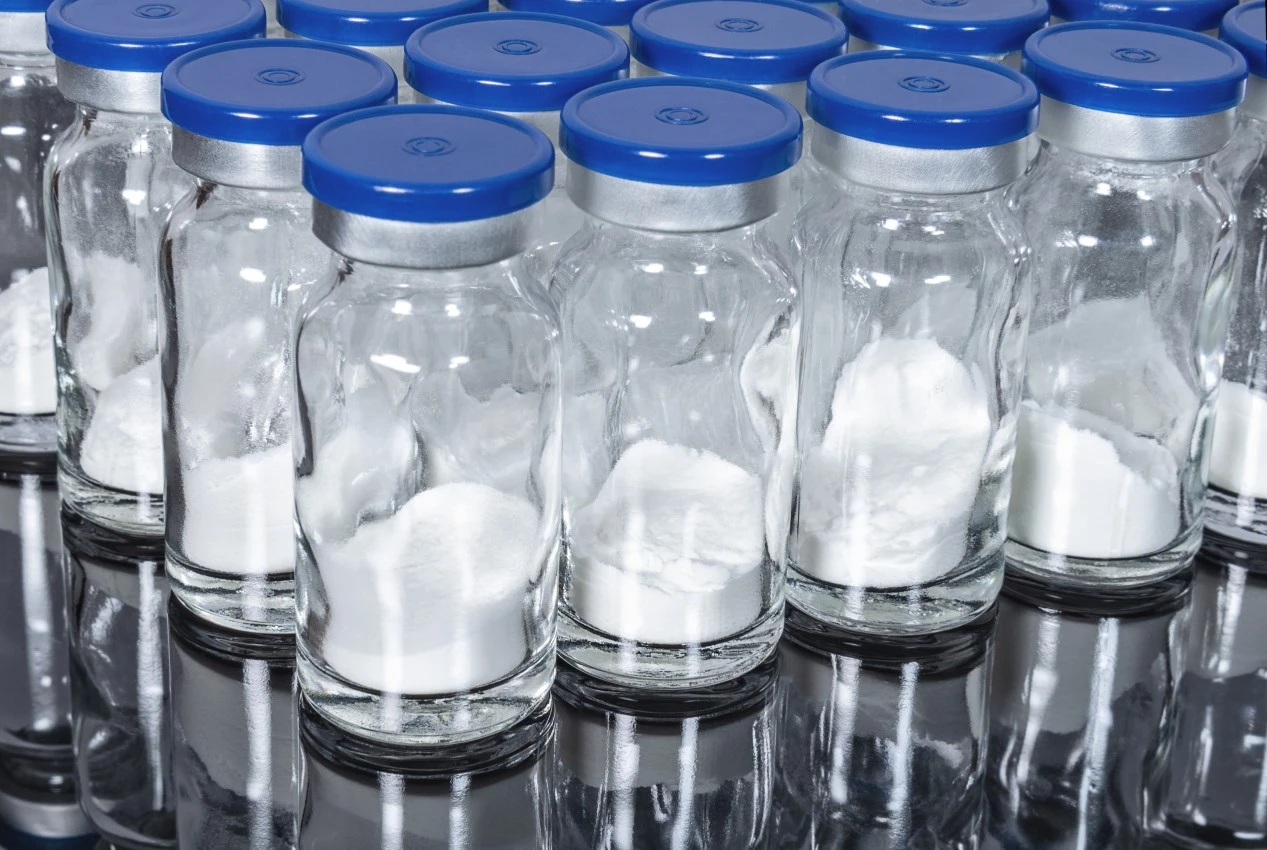
Lyophilised Peptides Explained
In laboratory research, peptides are frequently supplied as lyophilised peptides rather than as solutions. This presentation can raise practical questions: What exactly does “lyophilised” mean? Why does the vial sometimes appear empty? How does moisture affect the material? And what handling choices help preserve identity and quality during day-to-day experimental work?
This article explains the scientific rationale for lyophilisation (freeze-drying) of peptides, what researchers typically observe in the vial, and how to approach storage, documentation, and reconstitution planning in a neutral, laboratory-focused way.
What are lyophilised peptides?
Lyophilised peptides are peptides that have been freeze-dried to remove most water, leaving a dry solid (often a powder, cake, or thin film). The goal is not simply convenience; it is primarily about controlling chemical and physical stability during transport and storage.
Peptides in solution can undergo degradation pathways that are promoted by water, dissolved oxygen, light, heat, and pH-dependent reactions. By removing water, lyophilisation reduces the probability of many moisture-mediated processes and can extend the usable shelf life under appropriate storage conditions. The dry format is also easier to ship and store with less risk of leakage, microbial growth in aqueous media, or container compatibility issues associated with certain solvents.
Why peptides are often supplied as lyophilised material
Researchers encounter lyophilised peptide materials across many assay types, from biochemical binding studies to analytical method development. While the optimal presentation depends on the peptide and the downstream workflow, lyophilisation is common because it supports consistency and stability across a wide range of laboratory use cases.
- Improved stability in a dry state: many peptides are more stable with minimal residual moisture than in aqueous solution.
- Transport and logistics: shipping a dry solid generally reduces risks associated with solution freezing/thawing, leakage, or prolonged exposure to ambient temperatures during transit.
- Flexible experimental planning: laboratories can select solvent systems and concentrations appropriate for their specific assays, rather than working from a pre-made solution.
- Reduced container interactions: some peptides adsorb to plastics or may be incompatible with certain solvents over time; dry storage helps mitigate these issues until use.
For a broader view of how peptide quality is assessed and reported, see Peptide purity explained (HPLC/MS overview).
How lyophilisation works (high-level overview)
Lyophilisation is a controlled drying process designed to remove water while minimising chemical changes and preserving the material’s structure. Although implementations vary, the workflow typically involves:
- Freezing: the peptide solution is frozen, immobilising solutes in an ice matrix.
- Primary drying (sublimation): under reduced pressure, ice transitions directly to vapour (sublimates) rather than melting, removing the bulk of the water.
- Secondary drying (desorption): remaining bound or residual moisture is reduced further by continued vacuum and controlled temperature changes.
The result is a dry material that may appear as a fluffy powder, a porous “cake,” or a thin film on the vial wall. Minor differences in appearance can arise from concentration, excipients (if used), vial geometry, and the specific lyophilisation cycle.
What you may see in the vial: powders, cakes, and “invisible films”
One of the most common points of confusion with lyophilised peptides is visual: the vial may look empty, or the material may appear as a faint, transparent coating. This is often normal.
Why the vial can look empty
Some peptides form a thin, glassy film along the vial wall during freeze-drying. Under overhead lighting, this film can be difficult to see even though the expected mass is present. Tilting the vial or viewing against a dark background can sometimes make the film more apparent. A film-like appearance does not inherently indicate low quantity or poor quality.
Why different batches can look different
Two peptide vials with the same nominal mass may not look identical. Differences in residual moisture, counterion form, and how the material “sets” during freeze-drying can change the visual texture. The most reliable references for identity and specification remain the product documentation and analytical results rather than appearance alone.
Peptide content vs total vial mass: what “mg” can include
When working with lyophilised peptides, it is important to distinguish peptide content from total vial mass. The mass in the vial may include more than the peptide chain itself, such as:
- Counterions (salts): e.g., acetate, trifluoroacetate (TFA), chloride, or others depending on synthesis and purification.
- Residual moisture: even well-lyophilised materials can retain some water.
- Trace solvents or volatile components: depending on processing and drying endpoints.
This distinction matters for researchers because analytical methods, molar calculations, and cross-study comparisons may depend on whether you interpret the stated quantity as “peptide as received” or “peptide net content.” Suppliers vary in how they present these conventions, and the Certificate of Analysis (CoA) is often the best place to check what is reported and how identity and purity were verified.
For guidance on interpreting documentation, refer to How to read a peptide Certificate of Analysis (CoA).
Hygroscopicity: why lyophilised peptides can absorb moisture
Many lyophilised peptides are hygroscopic, meaning they can absorb moisture from the surrounding air. Moisture uptake can occur quickly after opening a vial, especially in humid environments, and can influence:
- Handling properties: a free-flowing powder may become sticky or clump.
- Weighing consistency: absorbed water can add mass and increase variability.
- Stability: water can promote hydrolysis or other degradation pathways for certain sequences.
From a workflow perspective, the practical implication is that researchers often aim to minimise how long the vial is open and to reseal it promptly. In settings where frequent access is required, aliquoting strategies may be considered to reduce repeated exposure of the entire stock to ambient air (design choices should be aligned with local laboratory practice and contamination-control requirements).
Storage principles for lyophilised peptides (lab context)
There is no single storage condition that fits all peptides, because stability depends on sequence, length, modifications, counterion form, and intended storage duration. However, several general principles commonly apply to lyophilised peptides in research settings:
- Keep sealed and dry: limit exposure to ambient humidity.
- Protect from heat: elevated temperatures can accelerate degradation reactions.
- Protect from light: some residues or labels may be light-sensitive.
- Reduce thermal cycling: repeated warming/cooling can increase condensation risk when a cold vial is opened in a humid room.
For a focused discussion of laboratory storage variables (temperature, light, and moisture), see How to store research peptides (temperature, light, moisture).
Condensation risk when opening cold vials
A common moisture pathway is condensation: if a vial is removed from cold storage and opened before it equilibrates, water can condense on the colder surfaces and contact the peptide. Many laboratories therefore plan handling so the container reaches an appropriate temperature before opening, reducing the chance of moisture introduction. The exact approach depends on the lab environment and the material’s sensitivity.
Receiving lyophilised peptides: what to check on arrival
Good handling starts at receipt. Lyophilised materials can be robust, but shipping conditions, packaging integrity, and documentation completeness all matter for traceability and experimental confidence.
- Verify labelling: confirm identifier, sequence name/code, and batch/lot number.
- Inspect the container: check cap integrity and signs of damage.
- Review documentation: confirm you have the CoA and any handling notes.
- Record receipt conditions: note any unusual transit observations relevant to your QA/QC processes.
For a structured checklist, consult Shipping and receiving: what to check on arrival.
Planning reconstitution: why some lyophilised peptides dissolve slowly
Lyophilisation produces a dry material, but it does not guarantee rapid dissolution in every solvent system. Solubility and dissolution rate are sequence-dependent and can also depend on how the peptide behaves physically after drying (for example, whether it forms aggregates or gels under certain conditions).
Common factors that influence dissolution
- Hydrophobicity: peptides with many nonpolar residues may have limited solubility in purely aqueous systems.
- Charge state and pH sensitivity: ionisable residues can change solubility depending on the solution environment.
- Aggregation propensity: some sequences self-associate, slowing dissolution.
- Modifications and labels: lipidation, cyclisation, or bulky tags can alter solubility and adsorption behaviour.
- Container interactions: adsorption to glass or plastic can complicate recovery for certain peptides.
Because research applications vary widely, suppliers typically avoid prescribing a single solvent “recipe.” Instead, researchers often evaluate solubility based on peptide properties, assay compatibility, and their laboratory’s validated practices. A conceptual overview is available here: Reconstitution basics: understanding peptide solubility (no protocols).
Quality and documentation: what lyophilised form does (and does not) imply
It is helpful to separate what lyophilisation accomplishes from what it does not.
- Lyophilisation can improve stability: by reducing water and enabling controlled storage.
- Lyophilisation does not inherently guarantee sterility: a dry peptide may still carry bioburden unless it has been manufactured and tested under conditions that support sterility claims (and those claims are explicitly documented).
- Lyophilisation does not define purity: purity is a function of synthesis and purification; it is typically assessed by analytical methods such as HPLC and MS and reported on the CoA.
When comparing materials, the most reliable approach is to consult the analytical data (identity confirmation, purity metrics, and any available notes on residual solvents, counterions, or water content) and match these to the needs of your experimental system.
Common laboratory best practices for handling lyophilised peptides
The specific procedures used in a laboratory will depend on local quality systems and the intended research use. The following practices are commonly considered when working with lyophilised peptides in a research environment:
- Traceability: record lot numbers, dates, and any internal identifiers in lab notebooks or LIMS.
- Minimise exposure: open vials only when ready to handle the material; reseal promptly.
- Use appropriate tools: use clean, dry implements to reduce moisture introduction and contamination risk.
- Avoid repeated access to the master vial: consider aliquoting approaches aligned with your workflow and QA/QC requirements.
- Document observations: note appearance, dissolution behaviour, and storage history when relevant to reproducibility.
These points are intended as research-handling considerations rather than prescriptive protocols. Always align your approach with institutional safety guidance and your experimental design needs.
FAQ: lyophilised peptides
What does “lyophilised” mean for peptides?
Lyophilised means the peptide has been freeze-dried to remove most water. This helps improve stability during storage and transport and allows the peptide to be supplied as a dry solid for laboratory research workflows.
Why are research peptides often supplied as lyophilised powders or films?
Many peptides are more stable in a dry state than in solution. Lyophilisation reduces moisture-related degradation and makes materials easier to ship and store under controlled conditions.
Is a lyophilised peptide sterile?
Not necessarily. Lyophilisation removes water but does not automatically guarantee sterility. Always refer to the product documentation and CoA for any available sterility or bioburden information.
Why does the peptide look like an invisible film or an “empty” vial?
Some peptides form a thin film along the vial wall during freeze-drying. Under certain lighting it can be difficult to see, even though the expected mass is present.
How should lyophilised peptides be stored in a lab?
Storage depends on the peptide and intended duration. In general, keeping lyophilised peptides sealed, dry, and protected from heat and light helps preserve quality. Follow supplier guidance for temperature and handling notes.
Can lyophilised peptides absorb moisture from air?
Yes. Many peptides are hygroscopic and can take up moisture quickly after opening. Minimising vial-open time and resealing promptly helps reduce moisture uptake.
What’s the difference between peptide content and total vial mass?
The total mass in a vial can include counterions (salts), residual moisture, and trace solvents in addition to the peptide itself. The CoA typically provides context on identity and purity; product documentation may specify content conventions.
Why might a lyophilised peptide be difficult to dissolve?
Solubility depends on the peptide sequence and any modifications. Hydrophobic regions, aggregation, pH sensitivity, and solvent choice can all affect dissolution. Reviewing documentation and choosing appropriate laboratory solvent systems can help.
Key takeaways
- Lyophilised peptides are freeze-dried to reduce moisture and support stability for research storage and transport.
- Appearance can vary widely; a thin film or “empty” look can be normal.
- Minimising moisture exposure after opening is important because many peptides are hygroscopic.
- Interpret quantity and quality using documentation, especially the CoA, rather than vial appearance alone.
- Dissolution behaviour is sequence-dependent; plan reconstitution based on peptide properties and assay compatibility.
For related guidance, explore the learning resources on storage, receiving checks, purity interpretation, reconstitution concepts, and CoA reading via the internal links above.