
Peptides vs Proteins, What Actually Separates Them
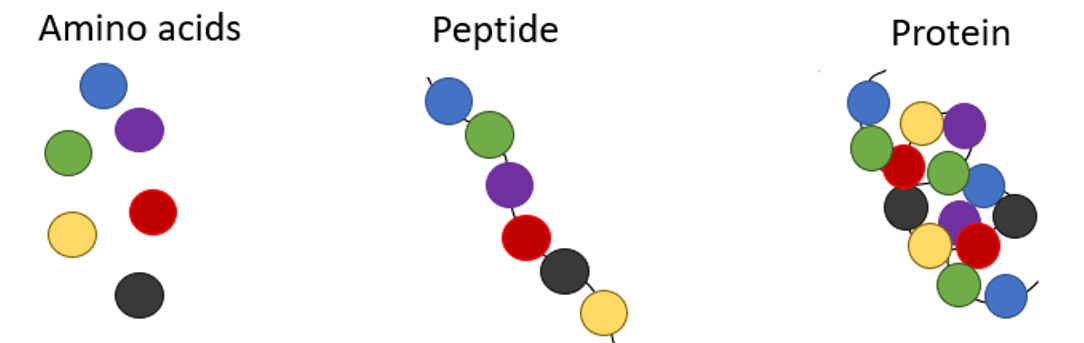
In laboratory science, the phrase peptides vs proteins comes up frequently, but the distinction is not always as simple as “short” versus “long.” Both peptides and proteins are chains of amino acids connected by peptide bonds, yet they differ in how researchers typically describe their size, structural behaviour, methods of production, and experimental roles.
This article explains what separates peptides from proteins using neutral, research-focused terminology. It also highlights where definitions overlap, why the boundary can depend on context, and how peptides, polypeptides, and proteins are commonly handled and verified in a research lab.
Shared foundation: amino acids and peptide bonds
Peptides and proteins are built from amino acids linked in a specific order (the sequence). The linkage between adjacent amino acids is the peptide bond, formed between the carboxyl group of one amino acid and the amino group of the next. This chemistry creates a repeating backbone that can adopt secondary structures such as α-helices and β-sheets under suitable conditions.
If you want a deeper chemical overview, see Peptide bonds explained. For a broader introduction to what peptides are in research settings, What are peptides? provides helpful background.
Size: the most common distinction (but not a universal rule)
When people ask about peptides vs proteins, they often expect a numerical cutoff in amino-acid count. In practice, there is no single universal boundary accepted across all disciplines. Still, some patterns are common:
- Peptides are often discussed as shorter, defined sequences, frequently used as chemical tools (e.g., binding motifs, epitopes, substrates, inhibitors) in controlled experimental systems.
- Proteins typically refer to longer chains that reliably adopt stable three-dimensional structures and perform biological functions such as catalysis, transport, signalling, or structural support.
Because “peptide” can refer to a wide range of lengths, researchers often add clarifying language—such as “short peptide,” “long peptide,” or “peptide fragment”—especially when comparing experimental workflows.
Why size alone does not settle the question
Two sequences of the same length can behave very differently. A moderately long chain may remain largely disordered in solution, while a shorter chain might adopt a stable helix under particular solvent, temperature, concentration, or binding conditions. The practical boundary therefore often depends on whether the chain forms stable tertiary structure and how it is used experimentally.
Structure: folding, domains, and stability
A central concept separating peptides from proteins is structural organisation. Protein science often assumes that a protein adopts a reproducible, functional three-dimensional arrangement (or a regulated ensemble of conformations) under defined conditions. Peptide research frequently focuses on shorter sequences where folding may be limited, conditional, or induced by binding partners.
Levels of protein structure
Proteins are commonly described using hierarchical “levels” of structure: primary (sequence), secondary (local helices/sheets), tertiary (overall 3D fold), and quaternary (multi-subunit assemblies). These terms are widely used in biochemical literature and are especially useful when discussing protein domains and multi-protein complexes.
For a structured overview, see Protein structure levels.
Peptide secondary structure is often context-dependent
Many peptides can form secondary structure—such as α-helices, β-hairpins, or turns—but this behaviour is often conditional. Factors that influence peptide structure in vitro include:
- Sequence composition (e.g., helix-promoting residues, proline/glycine effects)
- Length (short sequences may not support stable motifs on their own)
- Solvent and buffer conditions (pH, ionic strength, cosolvents)
- Concentration (aggregation or self-association can alter observed structure)
- Binding partners (structure can be induced upon binding to proteins, membranes, or nucleic acids)
In contrast, many globular proteins are expected to fold into a stable tertiary structure (or a stable set of conformations) that can be characterised by methods such as X-ray crystallography, NMR, cryo-EM, circular dichroism, or thermal stability assays.
Function and typical research roles
In lab contexts, peptides and proteins are often chosen for different experimental aims. This is not because peptides are inherently “less functional,” but because their scale, manufacturing route, and structural properties make them suited to different kinds of questions.
Common laboratory roles for peptides
Peptides are widely used as defined molecular tools in biochemical and molecular biology experiments. Examples include:
- Epitope peptides for antibody validation or assay development
- Protein-interaction motifs to probe binding interfaces
- Enzyme substrates for specificity and kinetics studies
- Standards for mass spectrometry workflows
- Fragments representing regions of larger proteins (e.g., loops, termini, phosphorylation sites)
Because peptide sequences can be specified precisely, they are useful for dissecting which residues are necessary for binding or recognition. Researchers may compare wild-type sequences with single-residue variants to test hypotheses about molecular interactions.
Common laboratory roles for proteins
Proteins are typically used when experiments require a complete folded domain or an intact multi-domain architecture. Examples include:
- Enzymes for catalysis studies and inhibitor screening
- Receptors and binding proteins to map ligand interactions
- Structural proteins in biophysical characterisation
- Complex assemblies to study quaternary structure and stoichiometry
In many cases, the research question is not “peptide or protein?” but rather which representation best matches the biological interface or mechanism being tested.
Terminology: peptide, polypeptide, and protein
Scientific language aims to be precise, yet everyday lab usage can vary. Understanding the terms helps interpret protocols, catalogue descriptions, and papers accurately.
Peptide
“Peptide” usually implies a defined amino-acid sequence, often shorter and frequently handled as a synthesised reagent. The term often carries a practical implication: the molecule may be treated more like a small chemical entity than like a folded macromolecule, even though it is still made of amino acids.
Polypeptide
“Polypeptide” is a broad term meaning an amino-acid chain, without necessarily implying a particular size or a stable folded structure. In different contexts, “polypeptide” can refer to:
- a longer peptide,
- a single protein subunit (one chain within a multi-chain protein), or
- a protein itself.
This flexibility is useful, but it can also be ambiguous. When reading a paper, look for additional cues such as molecular weight, domain architecture, or whether tertiary structure is described.
Protein
“Protein” typically implies a chain (or set of chains) that adopts a reproducible three-dimensional structure associated with a biochemical function. Even intrinsically disordered proteins are often considered proteins because they are expressed as gene products and can have regulated conformational ensembles and functional interactions.
Production and purity considerations in laboratory research
Another practical divider in peptides vs proteins is how they are produced and validated. Many peptides are generated by chemical synthesis, while many proteins are produced by recombinant expression. These routes influence impurity profiles, batch-to-batch variability, and the analytical tools used for verification.
Peptide synthesis in brief
Many research peptides are manufactured using solid-phase peptide synthesis (SPPS), which assembles the chain stepwise. SPPS enables precise control over sequence and facilitates incorporation of certain modifications, labels, or non-standard residues (depending on the synthesis design). However, longer sequences can be more challenging due to incomplete coupling, side reactions, and purification complexity.
For an educational overview of synthesis logic and common steps, see Peptide synthesis overview.
Protein expression and folding complexity
Proteins often require:
- Correct folding into a stable tertiary structure
- Disulfide bond formation (for some extracellular or secreted proteins)
- Post-translational modifications (in specific research contexts)
- Purification from a complex mixture of host proteins
These factors can make proteins more complex to produce and characterise. Recombinant expression systems (such as bacteria, yeast, insect, or mammalian cells) each have advantages and limitations that influence yield, folding, and modification patterns.
How peptides and proteins are commonly verified in research labs
Analytical verification is essential for interpreting experimental outcomes. The “right” methods depend on what must be confirmed: identity, purity, folding state, oligomeric state, or functional activity.
Typical peptide verification workflows
Peptides are often assessed with:
- Mass spectrometry to confirm molecular mass and support identity
- Analytical chromatography (e.g., HPLC/UPLC) to estimate purity and detect closely related impurities
- Amino-acid analysis (in some contexts) to support composition
Because many peptides do not have a unique folded structure, “verification” usually focuses on chemical identity and purity, along with any specified modifications (where applicable).
Typical protein verification workflows
Proteins are commonly assessed with:
- SDS-PAGE to evaluate apparent size and purity
- Size-exclusion chromatography to examine aggregation and oligomeric state
- Mass spectrometry for intact mass or peptide mapping
- Biophysical methods (e.g., circular dichroism, thermal shift) to probe folding and stability
- Binding or activity assays aligned with the research goal
Compared with peptides, proteins more often require confirmation of structural state (folded vs unfolded, monomer vs oligomer), because these properties can strongly influence experimental behaviour.
Handling and storage: why “small vs large” affects lab practice
Even when a peptide and a protein share a related sequence, their handling can differ because of solubility, stability, adsorption, and aggregation tendencies. These issues are not “good” or “bad,” but practical constraints to plan for during experimental design.
Peptide handling considerations
Peptides can be sensitive to:
- Moisture uptake (especially hygroscopic materials)
- Oxidation (notably for sequences containing methionine or cysteine)
- Adsorption to plastics at low concentrations
- Aggregation for hydrophobic or self-associating sequences
For research-focused guidance on minimising avoidable degradation and maintaining consistency, see Peptide storage and handling.
Protein handling considerations
Proteins may require additional attention to preserve folding and avoid aggregation, including careful buffer selection and temperature control during purification and storage. Because proteins can be marginally stable outside their preferred conditions, changes in pH, ionic strength, or freeze-thaw history can alter observed behaviour in assays.
Choosing between peptides and proteins in experimental design
In peptides vs proteins decisions, the most useful question is often: What needs to be represented to test the hypothesis? Some examples of how researchers choose include:
- Mapping a binding site: peptides can isolate a short interaction motif; proteins may be needed when binding depends on a folded domain or multiple contact surfaces.
- Testing enzyme specificity: peptides can serve as controlled substrates; proteins may be required to capture conformational effects or accessory domains.
- Generating assay standards: peptides can provide precise mass and sequence for analytical calibration; proteins may be used when the assay targets the intact macromolecule.
In many workflows, peptides and proteins are complementary: peptides help narrow down critical residues or motifs, while proteins validate whether the same features operate in a folded, domain-containing context.
FAQ
Are peptides just small proteins?
Peptides and proteins are both amino-acid chains, but proteins are typically longer and are defined by adopting stable, functional 3D structures (often with one or more domains). In practice, “protein” implies folding and function, while “peptide” often implies a shorter sequence used as a defined chemical tool in research.
How many amino acids makes a peptide vs a protein?
There isn’t a universal cutoff. Many researchers use “peptide” for shorter sequences and “protein” for longer sequences that form stable structures, but the boundary can vary by discipline and context.
What is a polypeptide—peptide or protein?
“Polypeptide” is a broad term meaning an amino-acid chain. It can refer to a longer peptide, a protein subunit, or sometimes a protein itself depending on context.
Do peptides fold like proteins?
Some peptides can adopt secondary structure (like helices) under certain conditions, but many do not form the stable tertiary/quaternary structures that are typical of proteins. Folding depends on sequence, length, and environment.
Why are proteins usually harder to produce than peptides?
Proteins often require correct folding, disulfide formation, and sometimes post-translational modifications. They’re commonly produced via recombinant expression and purification, which adds complexity compared with synthesising many shorter peptides.
How are peptides and proteins commonly verified in research labs?
Peptides are often checked using mass spectrometry and analytical chromatography, while proteins are frequently assessed using techniques like SDS-PAGE, size-exclusion chromatography, and functional or binding assays—chosen according to the research goal.
Key takeaways
- Peptides and proteins share the same chemical backbone (amino acids linked by peptide bonds), but they are often distinguished by typical length and whether stable tertiary structure is expected.
- “Protein” usually implies folding and domains, while “peptide” often implies a defined sequence used as a controlled reagent or fragment in experiments.
- “Polypeptide” is a flexible term that can refer to an amino-acid chain of various lengths, sometimes overlapping with either category.
- Verification strategies differ: peptides often emphasise mass and chromatographic purity; proteins often add structural state, oligomerisation, and functional readouts.
For additional educational reading relevant to peptide work in the lab, explore What are peptides? and Peptide synthesis overview, and for practical handling considerations see Peptide storage and handling.